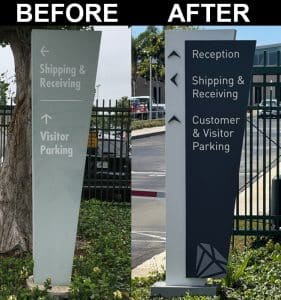
 North Coast Signs, based in nearby Vista and serving Carlsbad, walks a facilities manager through the five decisions in a twenty-year parking-lot rebuild, from edge-free push-through lettering to the retroreflective sheeting grade that decides the night read.
A parking lot rebuild is five decisions, and the sign face is only one of them. The other four decide whether the new signs still point people where they need to go, hold up in the sun, and read at night, years after the crew leaves. A long-standing commercial campus in Carlsbad came to us with a dozen rusted directionals, two tired monuments, and a lot that had quietly changed under them. The scope looked overwhelming until it was sorted into five clear jobs. Here they are, in the order they get made.
Build Letters With No Edge to Fail
The first decision is how the letters are made, because that is what failed on the old signs. Cut vinyl lifts at the edge, where the adhesive sits exposed to wind, moisture, and sun, so it curls, chalks, and ghosts long before the metal gives out. We route the aluminum face and push white acrylic letters through it, so each character is a captured piece of the panel with no adhesive edge to attack. Acrylic holds its color in constant sun far longer than a cut-vinyl film, so the lettering stays clean rather than fading to the twenty-year look being replaced.
Reset the Footings Under Every Sign
The second decision sits underground where nobody sees it. A directional post has to resist the overturning force that wind puts on its face, so the concrete base is a wind-load calculation, not a hole. On the campus we pulled the old two-foot bores, which had aged and no longer sat where the lot needed them, and hand-dug fresh eighteen-to-twenty-four-inch footings for new two-inch steel poles. Skipping that and re-lettering the existing posts would leave the new signs standing on old assumptions about where people drive.
Put the Signs Where the Lot Goes Now
The third decision is where each sign lands. North Coast Signs, based in nearby Vista, works these campuses often enough to know that a lot from twenty years ago is not the lot today. On this one the EV-charger rows did not exist when the original signs went in, so drivers were hunting for turns the old wayfinding never marked. We re-positioned several directionals to match the routes people drive today, which is the difference between a lot a stranger can follow and one that steers everyone to the old traffic pattern.
Spec the Night Read
The fourth decision is the one nobody prices, the night read. A directional gets its headlight visibility from retroreflective sheeting, and that sheeting comes in grades that have moved on. The old engineer-grade film standard when these signs went up is no longer the accepted bar; current high-intensity prismatic sheeting runs about three times brighter and holds its color for a decade or more. Replacing tired signs is the moment to upgrade the night read, so a driver scanning for the exit or the chargers finds the sign in the headlights.
Make Twelve Signs Read as One System
The fifth decision ties the other four together into one look. A dozen signs and two monuments only work if they read as one system, so we hold every cabinet to the same routed aluminum in Matthews white, the same PMS Cool Gray pair, and the same half-inch black acrylic arrows across the lot. Consistency is what turns a set of individual signs into wayfinding a stranger can follow without thinking, from the entrance to the far corner.
One pass that fixes the lettering edge, resets the footings, corrects the positions, and specs the night read is what makes the lot hold day and night and stay solved. Call North Coast Signs at (760) 536-5454 and we will walk your lot and map the routes before we quote a single sign, so the rebuild answers all five decisions at once.



Leave a Reply