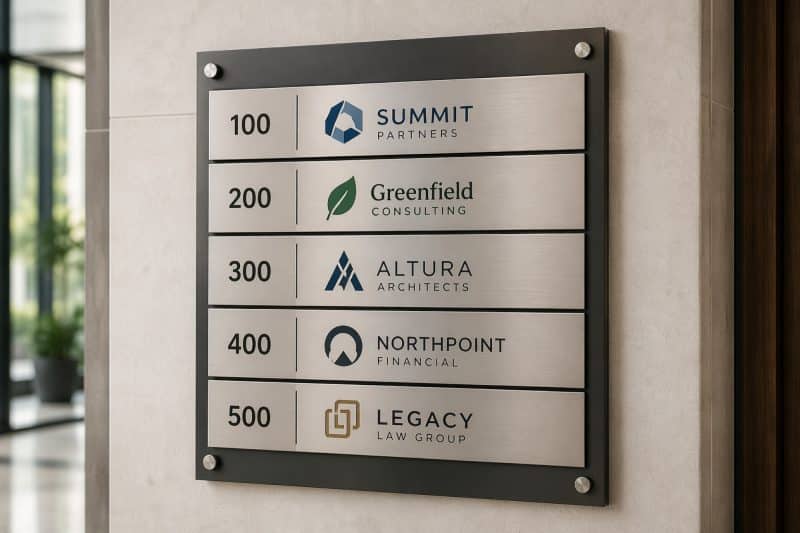
Tenant panels are the sign category with the lowest profile and the highest failure rate. A customer trying to find a specific suite, office, or retail space inside a commercial property depends on the tenant panel to do its job, and when the panel fails the tenant loses the foot traffic while the property manager and sign vendor lose nothing. North Coast Signs, located in Vista, CA, fabricates and installs tenant panel signs, and the five types below are the ones that show up most often. Each section below covers what the panel type is, what it does, and where it typically fails.
Monument Tenant Panels
Monument tenant panels are panels inserted into or mounted onto a shared monument sign structure at a property entrance. Multiple tenants appear on the same monument, which means every panel has to coexist visually with the panels next to it. The failure mode is color drift: the first panel fades under sun exposure, and a replacement panel installed next to the faded original looks mismatched even when the spec sheet says they should match. Property managers who plan monument panels as a replaceable set avoid this problem.
Pylon Tenant Panels
Pylon tenant panels are slots on multi-tenant pylon signs along commercial corridors and roadside locations. Position on the pylon determines visibility from the road, and top slots get more attention than lower slots because of how drivers scan signage at speed. The failure mode is tenant position mismatch: a new high-value tenant lands in a lower slot because the higher slot is locked to a legacy lease, and the new tenant loses visibility they are paying for. Pylon layouts negotiated during lease discussions prevent the problem before the panel ever gets fabricated.
Directory Tenant Panels
Directory tenant panels are wayfinding panels inside office parks, medical plazas, and mixed-use retail centers with multiple suites. The directory tells the customer which suite to walk to, and a good directory does that job in under three seconds. The failure mode is swap-out design: directories built without a clean panel replacement system force the property to remove adjacent panels when one tenant moves out. A directory with independent panel slots turns tenant turnover into a ten-minute swap instead of a half-day rebuild.
Backlit Tenant Panels
Backlit tenant panels are illuminated panels for interior corridors, covered exteriors, and any location where the panel needs to read under low light. LED and older fluorescent systems are the two illumination categories, and LED retrofits of fluorescent systems are where most failures start. The failure mode is uneven illumination: hotspots appear where LEDs sit close to the panel, and dark zones appear between light sources. A diffusion layer spec’d to the new illumination source eliminates both problems when the retrofit is done right.
Routed Aluminum Tenant Panels
Routed aluminum tenant panels are CNC-cut aluminum panels with dimensional letters or shapes cut through the material itself. The finish options include paint and powder coat, and the choice between them determines how the panel ages in the environment where it lives. The failure mode shows up at the routed edges first, where paint chips under exposure while powder coat bonds more completely to the cut surface. Coastal commercial properties where salt air is a factor should spec powder coat without exception.
Choosing the Right Tenant Panel for Your Commercial Property
Tenant panels are not interchangeable, and specifying the wrong type for a property creates problems that outlast the panel itself. Call North Coast Signs in Vista at (760) 536-5454 for tenant panel fabrication and installation that takes the long view on wayfinding, illumination, and finish.